
Innovative testing technology on track
Brake Testing Solutions
Unsere Prüftechnik und Methodik überzeugt auch auf Schiene.
Brake Testing
The european Union´s goal is to reduce greenhouse gas emissions to zero by 2050. A major contribution to achieving this will be a shift of more and more passenger and freight traffic to the railways.
A key strategy for increasing efficiency in the rail sector is the use of lightweight construction concepts, in particular in the unsprung mass of the wheelset, including the brake components. The modern braking systems for rail vehicles are critical equipment for safety, meaning they are subject to stringent requirements in terms of safety, availability and comfort.
Wear-free braking systems such as regenerative braking are used most commonly for service braking. The main advantages include energy recovery, good controllability, a large thermal capacity and
low-maintenance operation.
In terms of safety, however, the highest level of reliability is still achieved with friction brakes, such as block or disc brakes.
What is known as “brake blending” is used to enable the available braking systems to interact in one
system.
From the very beginning of development of braking systems, test bed trials play a central role in ensuring functional safety and reliability.
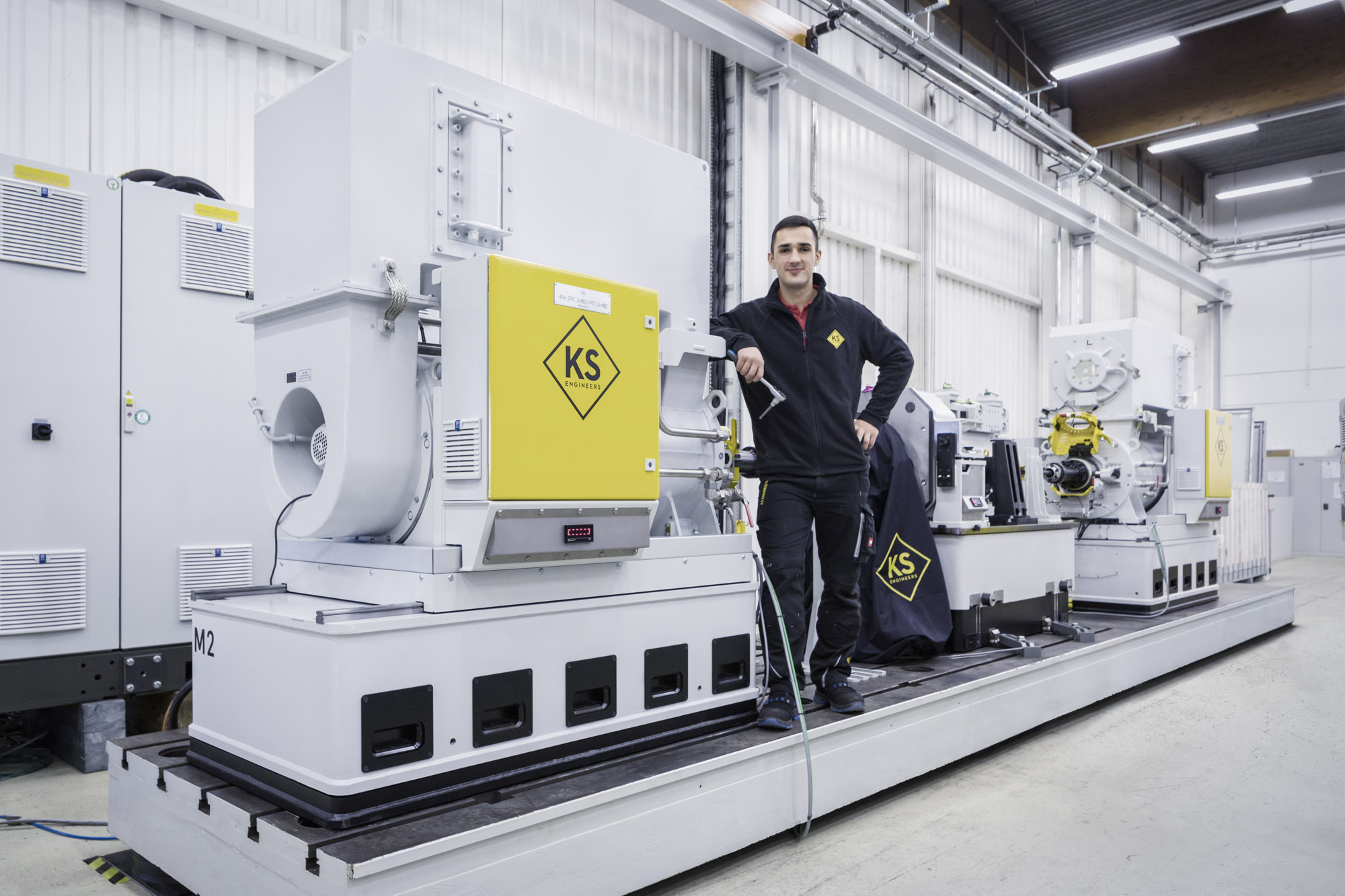
The custom testing technology KS Engineers offer provides the flexibility required to deal with the most diverse scenarios and testing tasks. Following an order placed by the operator PBS Testing – Prüfinstitut für Betriebsfestigkeit und Schienenfahrzeugtechnik GmbH, an innovative, universal brake Dynamometer for testing rail vehicle friction brakes was developed at the Graz University of Technology. Disc brakes, block brakes and wheel disc brakes can be tested, along with the associated brake callipers, brackets and brake backing plates, as well as the Composite system.
Test bed design
In conventional test beds for examining friction brakes for rail vehicles, the real vehicle is simulated by means of mechanical flywheels in combination with a comparatively small electric motor. This involves
manually or automatically coupling the selected flywheel mass combination while at a standstill. The discrete levels of the flywheel masses mean that additional drive or braking force must be applied by the electric motor depending the required load
profile.
If the braking force demand on the friction brake varies greatly, deviations from real operation may occur during a series of tests.
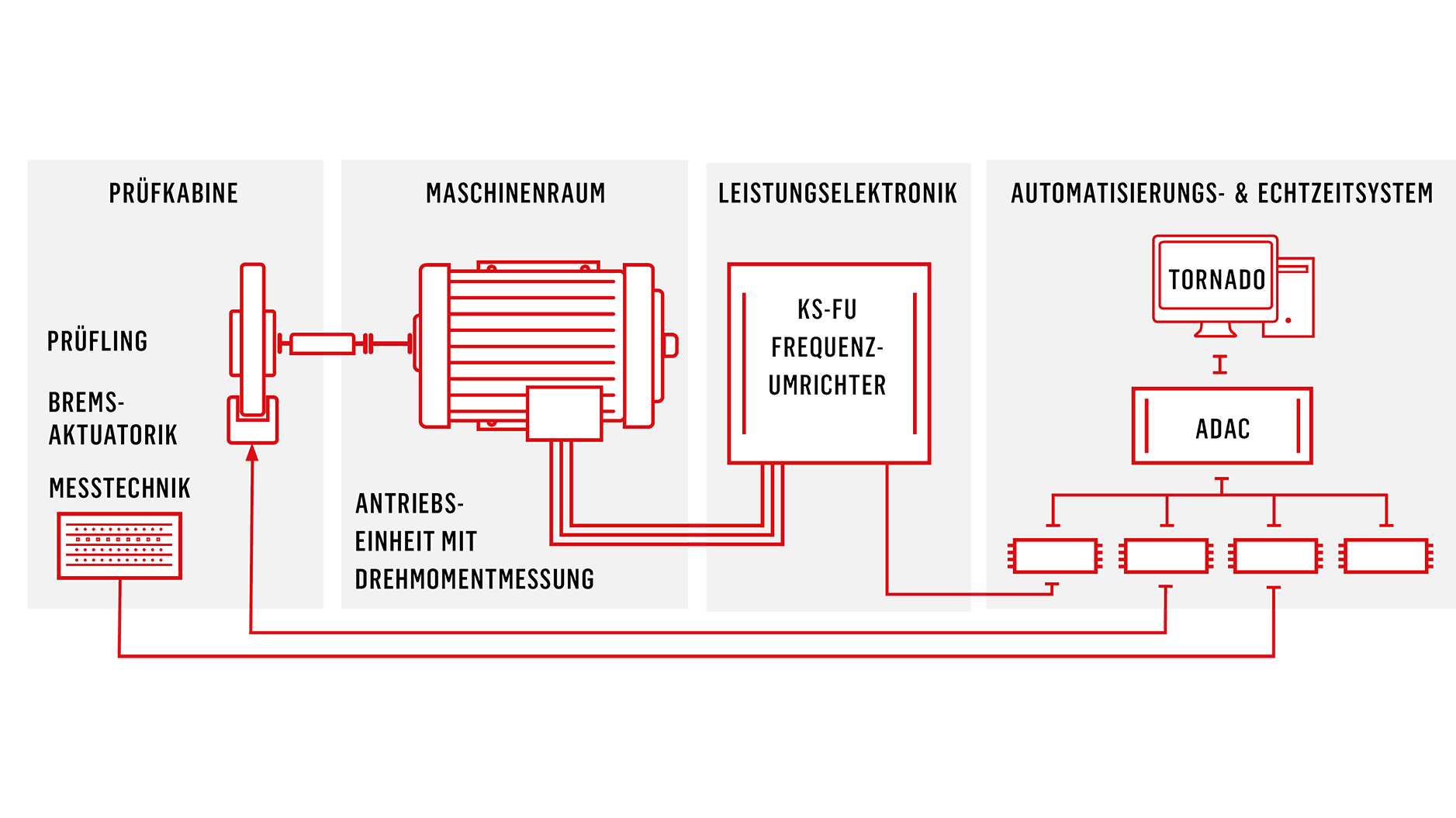
This innovative concept enables flexible test scenarios and provides a visualization of rapidly changing operating states. Eliminating mechanical flywheels offers considerable advantages. Mass simulation on the test bed is accomplished on a purely electrical basis using a comparatively powerful electric motor. This innovative drive concept opens up the possibility of simulating a large number of real, vehicle-specific operating scenarios, such as braking with highly variable masses to be braked, braking to a complete standstill including simulation of the final jerk when stopping, and parking brake tests, all with no need for any modification or set-up work.
The powertrain is very compact and rigid due to the mass simulation being exclusively electrical and the associated elimination of mechanical flywheel masses and all associated attachment units. The very simple mechanical design also reduces the powertrain’s susceptibility to vibration to a minimum. The basis for this is powerful and highly dynamic control and power converter technology.
The vehicle inertia and the optional active torsional vibration damping are adjusted in real time. The test bay consists of two test chambers, each with its own electric machine. These two test beds can be operated at the same time independently of each other.
Additionally, these two test beds can be coupled virtually by means of a shared vehicle simulation, for example to investigate the braking behaviour of a series of vehicles attached together which are equipped with both block brakes and disc brakes. By installing the brake disc in one test chamber and the block brake in the other, no additional fixtures are needed – unlike with standard testing approaches.
Icon
